

Discover The American School of Tegucigalpa
The American School of Tegucigalpa (AST), established in 1946, is a private, coeducational day school offering a nursery through grade 12 college-preparatory program. With a school year running from August to May, AST provides an English-based curriculum accredited by Cognia, the Honduran Ministry of Education, and the International Baccalaureate (IB) Organization for the diploma program.
The school emphasizes bilingualism, offering instruction in both English and Spanish to students of all nationalities, with no religious instruction included. High school students engage in rigorous coursework across core subjects, alongside electives and interscholastic sports programs. AST is governed by the Sociedad Educacional Interamericana de Tegucigalpa, with parental membership tied to student enrollment.
Home to 1,059 students and 121 highly qualified faculty members from diverse nationalities, AST fosters a multicultural environment. The school features state-of-the-art facilities, including science and computer labs, music and art rooms, a media center, a gymnasium, and a Performing Arts Center. Outdoor facilities include covered basketball courts and an artificial turf soccer field. AST is dedicated to maintaining small class sizes, averaging 20 students per teacher, ensuring personalized attention and academic excellence.
AST Through the Years

1946

The first bilingual school in Tegucigalpa is established.
In the mid-1940s, American companies began establishing their operations in Honduras. Many employees migrated with their families, creating the need for a quality bilingual education for their children. Recognizing this need, the American Embassy decided to take on the task of founding the country’s first bilingual school. Mr. James Webb, the American Embassy’s Cultural Attaché, served as a liason between American families and a group of visionary Honduran investors committed to the project.Their collaboration led to the creation of The American School of Tegucigalpa in 1946. The school first opened its doors in Barrio La Ronda, in downtown Tegucigalpa. A small group of 42 students divided into three classrooms begun ASTs legacy of excellence in bilingual education.
1950

Honduran and US educational systems are integrated.
From its inception, The American School of Tegucigalpa integrated both the American and Honduran educational systems. Its first director, Mrs. Mary Sager, led grades three through six, setting a standard of professionalism and dedication that shaped the school’s future. She was later joined by Mrs. María Teresa Castro de Ellison (sub-director) and Mrs. Matilde de Izaquirre. High school classes initially operated through correspondence with the University of Nebraska and the University of Galvet, and was supervised by an American professor. Graduation classes during the 1950s and 1960s ranged from three to twenty students. The first graduates officially recognized by the Honduran government—Lottie Izaguirre, Margarita Elvir, Eca Zepeda, and Federico Brevé—became pioneers, opening the door for future generations of students who wanted to pursue a high-quality bilingual education in Honduras.
1954

The Sociedad Educativa Interamericana de Tegucigalpa (SEIT) is born.
Mrs. Izaguirre took on a greater administrative role, further integrating the American and Honduran education systems. In 1954, the Sociedad Educativa Interamericana de Tegucigalpa (S.E.I.T.) was established. SEIT was composed of parents committed to maintaining the school’s high-quality bilingual and bicultural education—a role it continues to fulfill today. As enrollment grew, satellite classrooms were opened near Parque Finlay and Calle Las Damas. The School also introduced a three-year Bilingual Commercial Secretarial program, which was later discontinued due to logistical difficulties.
1957

Land donation for AST's current location was negotiated.
To find land for the construction of a larger school, negotiations between members of the US Embassy, the American School, and the Honduran government begun in the late 1950s A collaborative effort between the SEIT Board president, Mr. Augusto Rodriguez Ulloa and Mr. James Web brought about the donation of the land where the American School of Tegucigalpa is built upon today. Honduran President, Dr. Juan Manuel Galvez, donated the land (originally owned by Don J. Alfonso Mejía). The government initially proposed one of two locations: a lot in Colonia EL Pedregal, in Comayaguela, and a lot in a section of the outskirts of Tegucigalpa, which later became known as Las Lomas del Guijarro. The U.S. Embassy donated $100,000 for the construction of the new school. With this funding, the school begun its construction, dug a water well, a purification system for the water and purchased school buses. The school was initially equipped to accept 500 students.
1962

The new school building is inaugurated.
In 1962 the new school building was inaugurated in the southeast portion of Tegucigalpa. Once in the new building, organized sports and activity clubs were formed. Initially the school had science, drama, journalism and photography clubs. With the support from the Faculty of Michigan State University, Mr. Guillermo Inestroza consolidated the science program for 10th and 11th grades. Mrs. Nury Reyna Toffe who joined the school in the late 1960s helped to further develop AST’s art department.
1970

Mr. David Losk begins his Journey at AST
1970 brought the arrival of Mr. David Losk, who assumed the positions of teacher, principal and rector. ASTs high educational standards during the 70s allowed for graduating seniors to get admitted to universities like Georgetown, Yale, Stanford, and others. This decade also brought with it the construction of ASTs first basketball courts, and a cafeteria building. The gymnasium was revamped to include a stage for the performing arts, and the school created a band and drama deparments. ASTs first library buildling was also built in the late 70s.
1988

New Facilities to Meet the Growing Needs of the AST Community
During a time when AST was in urgent need of expanding its facilities, significant developments took place under the leadership of SEIT's president, Richard Zablah, and the unwavering help and support of the newly appointed Superintendent — Dr. James Sheppard. During this term, the school saw the construction of new High School and Preschool buildings, as well as a new gymnasium/auditorium—all major steps in meeting the growing needs of the Eagle community. Over the course of Dr. Sheppard's seven years at the school, AST also achieved accreditation from the U.S. Southern Regional Board of Education. This milestone, helped position AST as one of the leading bilingual schools in the region.
1990

Mrs Izaguirre retires after 40 years serving as ASTs Director
In 1990, Mrs. Matilde Izaguirre, who was the first Honduran Director at AST, retired after 40 years of service to AST. Mrs. Linda Matamoros de Durón replaces her as the new director. The Class of 1990 was the first graduating class to have their graduation ceremony in the new school auditorium, and not at the Teatro Manuel Bonilla. The new High School building was inagurated and dedicated to Mrs. Matilde Izaguirre in honor of all her years of hard work at AST. The Class of 1991 was the first group of Eagles to spend their senior year in the new building. During the 1995-1996 school year, the Preschool was moved from the elementary school building to it’s brand new home at the entrance of the campus. In the late 1990s (circa 1998) there was a short circuit that sparked a fire on the roof of the middle school building. By 2000, AST had new middle school and the very first middle school principal.
2012

A two-story Dinning Hall
is Built
Originally built in the 1970s, AST’s cafeteria was a modest one-room facility with a single serving counter. For many years, it was managed by the Parent Teacher Organization (PTO), with Mr. Franklin Hasbún and his wife, Mrs. Betty, overseeing operations during the final 12 years of the original structure. Their dedication created lasting memories for generations of Eagles. In 2008, a fire damaged much of the cafeteria, leading to the closure of a significant portion of the building. In 2012, AST replaced the structure with a modern, two-story Dining Hall. That same year, the school welcomed back alumna Angélica Díaz del Valle (Class of 1997) to manage the new facility. Since then, Angélica and her team have provided diverse, high-quality meals and have catered countless school events. The Dining Hall was officially dedicated to all past, present, and future AST teachers, recognizing their invaluable contributions to the school community.
2015

A decade of modernization and progress begins
In 1998, Mrs. Liliana Flefil de Jenkins became AST’s Superintendent—the first Honduran and the first AST alumna and former faculty member to hold the position. Her leadership marked a decade of significant academic, infrastructural, and athletic development, reflecting the school’s evolving vision and commitment to excellence. Key academic initiatives during this period included reducing class sizes to 20 students for more personalized instruction, adopting online curricula, implementing student management systems, and redesigning classrooms to promote interactive learning. Working in collaboration with SEIT President José Francisco Quiñonez, Mrs. Jenkins supported major infrastructure projects such as the renovation of Preschool and Elementary School buildings and the transformation of the South Parking Lot into a three-level garage. The Athletic Department also saw substantial growth. New programs focused on developing student-athletes, while improvements to facilities included the installation of light fixtures for the artificial turf soccer field, specialized flooring for the covered basketball courts, and the addition of a fitness center on the gymnasium’s first floor. This decade stands out as a time of modernization and meaningful progress across all areas of school life.
2018
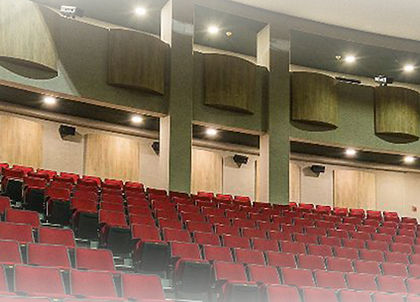
Performing Art Center opens its doors
In early 2018, AST celebrated the opening of its Performing Arts Center (PAC), a modern, purpose-built facility that marked a major milestone in the school’s commitment to the arts and community engagement. Construction began in 2016 under the leadership of SEIT President Dennis Figueroa and was completed and officially inaugurated in 2018 by SEIT President Reina Irene Mejía. Since then, the PAC has become a cornerstone of school life and tradition. Its 400-seat auditorium has hosted a wide range of events, including theatrical productions, music performances, graduation ceremonies, honors assemblies, and other important school gatherings. The Performing Arts Center stands as a testament to the school’s ongoing investment in creativity, student expression, and community celebration.
2020

Difficult times bring out resilience and creativity.
The COVID-19 pandemic presented unprecedented challenges, but AST responded with resilience, adaptability, and a strong sense of community. Among bilingual schools in the region, AST was a leader in safely reopening its campus, ensuring that academic and extracurricular activities continued with care and responsibility. In May 2020, the school hosted its first-ever virtual graduation for the Class of 2020. A year later, AST celebrated its first outdoor graduation—thoughtfully designed for the Class of 2021, who had spent their entire senior year learning remotely. Step by step, life at AST resumed, guided by the determination and unity of students, families, faculty, and staff. The spirit of the AST Eagle—resilient, creative, and committed—was never more evident than during this extraordinary time.
2023

La Cumbre Parking Lot is Developed
As traffic in Tegucigalpa became increasingly complex, AST responded with a solution to improve accessibility and ease congestion during peak hours. Under the leadership of Superintendent Mrs. Liliana Jenkins and in collaboration with SEIT President José Rafael Rivera, the La Cumbre Parking Lot was developed and inaugurated. Strategically located to serve families arriving from the northern part of the city, this new facility significantly streamlined school drop-off and pick-up, enhancing daily convenience for both students and parents. The project reflects AST’s ongoing commitment to adapting to the needs of its community while prioritizing safety, access, and efficiency.
2025

AST Classrooms and Cafeteria are Air-Conditioned.
Over the year's, Tegucigalpa's climate has shifted significantly, with rising temperatures making air conditioning a necessity. In 2024, under the leadership of Jose Rafael Rivera and Mrs Liliana Jenkins, SEIT made the decision to equip all four school buildings with air conditioning. By early 2025, the Preschool and Elementary school classrooms were fully air-conditioned, with plans to extend this upgrade to middle school and high schools upon completion of the scheduled building renovations.